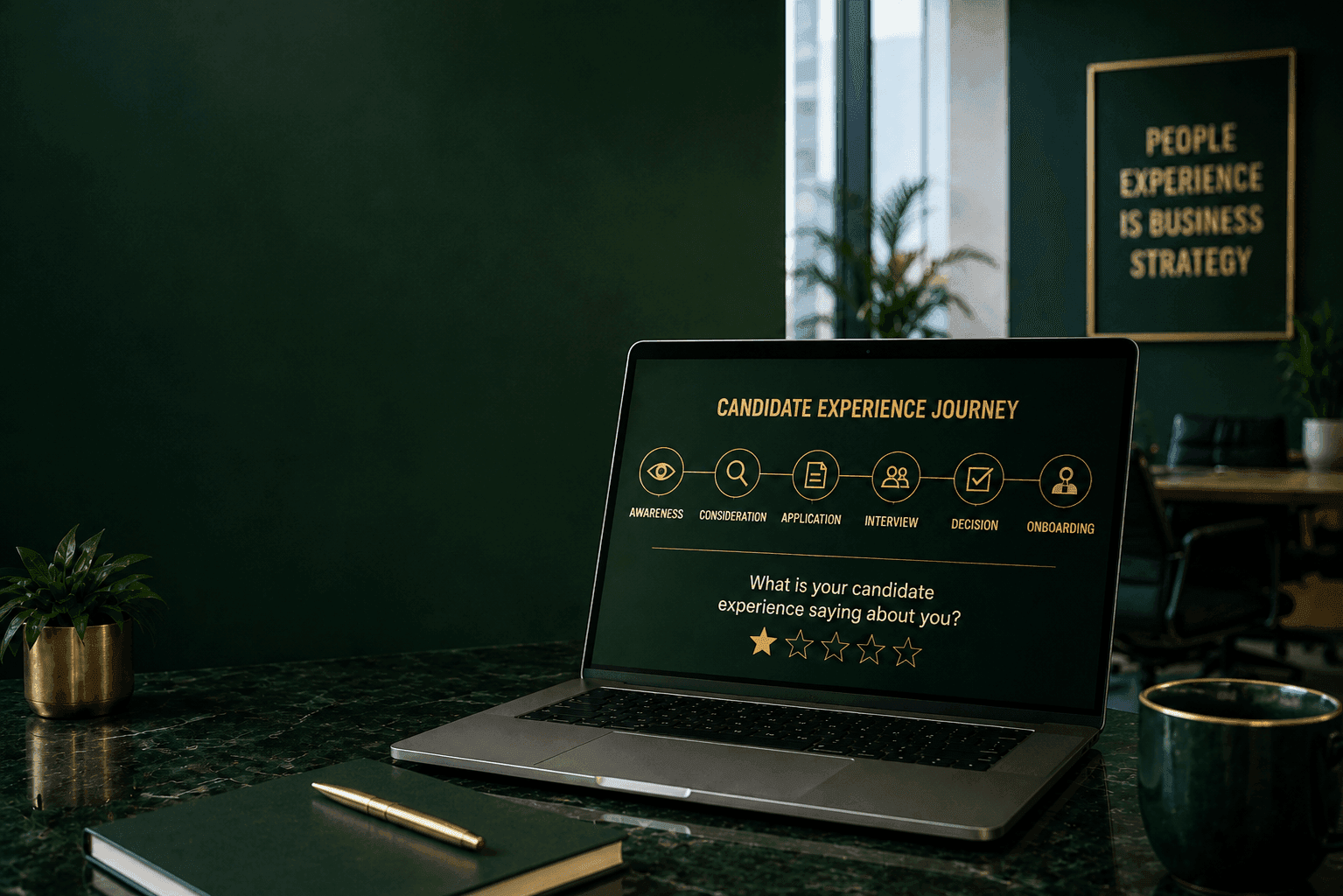
How candidates experience your hiring process is how they experience your company. In a market where employer reputation travels at the speed of a LinkedIn post, the gap between your intended and actual candidate experience has direct business consequences
Job seekers today arrive at your application process better informed, more discerning, and considerably less patient than they were even five years ago. Before they send a single application, they have researched your organization across multiple platforms. They have read Glassdoor reviews, spoken to former employees, and compared your roles against competitors. They have benchmarked your compensation against the market, assessed your culture through LinkedIn posts, and formed a detailed impression of what it would feel like to work for you.
And here is the part most organizations underestimate: by the time a strong candidate clicks Apply, they have already made a preliminary judgment about your company. What your hiring process does next either confirms it or contradicts it. In most cases, it contradicts it. And the candidate moves on.
The candidate experience is not an HR process. It is a brand signal. And most organizations are sending a signal they have never consciously designed.
The Power Shift Is Already Complete
For a period, particularly during tight labour markets, the power dynamic in hiring temporarily shifted back toward employers. Candidates would accept longer processes, fewer touchpoints, and less transparency simply because options were limited and desperation set in. Companies grew complacent. Multi-stage interview processes ballooned. Response times stretched. Communication became an afterthought.
That window has closed. The balance has shifted again, reinforced this time by technology, by the expansion of remote work, and by a generation of professionals who have grown up comparing experiences the way they compare products.
Candidates now move quickly. They apply to multiple roles simultaneously, compare response times across organizations, and withdraw from processes that feel slow, impersonal, or disorganized. And they talk. Glassdoor. LinkedIn. Industry Slack groups. A poor hiring experience does not stay between the candidate and your HR team. It gets written down and shared.
The best candidates, the ones you most want, have the most options. They also have the least tolerance for a poor experience. That is not a coincidence. It is a market reality.
An application process that takes four weeks, includes three rounds of interviews that could have been consolidated into two, and closes with silence rather than a clear outcome is not a neutral experience. It is a data point. And it is being shared.
What Candidates Are Actually Evaluating
Candidates are not just evaluating the role. They are evaluating the organization. Every touchpoint in your hiring process, from the language in the job description to the conduct of the interview panel to the timing and tone of the rejection letter, communicates something about your culture, your leadership, and your operating standards.
Most candidates are not consciously tallying this. They are just forming a feeling. And that feeling drives the decision.
The specific signals that carry the most weight:
Clarity of communication. Does the organization tell candidates what to expect, when to expect it, and what comes next? Organizations that go silent after an interview stage are communicating something. It is not that they are organized and respectful of people's time. Candidates feel the silence as disrespect, and they remember it.
Consistency between what is described and what is experienced. The job description says collaborative culture. The interview panel is visibly siloed, unprepared, and seems to be meeting each other for the first time. Candidates notice the gap immediately. What they are seeing is not an anomaly. They understand they are seeing the organization as it actually is, and they draw the obvious conclusions.
Respect for the candidate's investment. A serious candidate preparing for a senior role may invest six to ten hours across research, preparation, and multiple interview rounds. Organizations that provide no feedback, no timeline transparency, and no closure at the end of that investment are not just being discourteous. They are telling the candidate exactly how they treat people who are not yet on the payroll. And candidates draw the obvious conclusion about how they will be treated once they are.
The quality of the interviewers. Hiring managers who have not read the candidate's profile, who ask questions that could have been answered by a two-minute LinkedIn review, or who spend the interview talking about themselves rather than listening, are not just failing to make a good hiring decision. They are representing your organization at the moment that matters most. And they are doing it badly.
The speed of the process. Time kills candidates. Not just because competing offers emerge, though they do. But because a slow process signals indecision, internal dysfunction, or lack of respect for the candidate's time. Strong candidates read delay as a sign of how decisions get made inside the building.
The Connection to Employer Brand
Every candidate who has a strong experience, even if they do not receive an offer, becomes a potential brand ambassador. They tell peers the process was professional, that communication was clear, that they were treated with respect even when the answer was no. That story circulates.
Every candidate who has a poor experience becomes a potential detractor. In industries where talent pools are concentrated and professional communities are small, the arithmetic of your candidate experience compounds quickly. Candidates who were treated poorly are also customers, referral sources, and future applicants. They are reviewers, and storytellers.
Organizations with consistently high-quality candidate experiences report shorter time-to-fill for critical roles, stronger offer acceptance rates, and a higher calibre of applicant entering the funnel. The investment in getting this right pays back measurably, and the cost of neglecting it compounds invisibly until it becomes impossible to ignore.
Where to Start
The most practical starting point is not redesigning the entire hiring process. It is auditing what candidates are actually experiencing right now, not what HR believes they are experiencing.
That means sitting in on interviews as an observer, not a participant. Asking recently hired employees, six to twelve months in, what surprised them about the process and what they would change. Conducting brief structured conversations with candidates who withdrew partway through. Tracking response times at every stage and identifying where candidates are waiting longest. Mapping the funnel to see where strong candidates are dropping off, and asking why.
The answers are almost always instructive and often uncomfortable. Most organizations discover that their strongest candidates are withdrawing at the second or third stage, not because of compensation, but because a competing organization moved faster or communicated more clearly.
The highest-impact changes are rarely technical. They are behavioral: training interviewers to prepare properly, building standardized communication templates for every stage of the process, committing to specific response windows and holding to them, providing outcome communication to every candidate who reaches an interview stage, and reviewing job descriptions annually to ensure the language reflects the actual role rather than an aspirational version of it.
None of this requires significant budget. It requires intention, consistency, and the discipline to hold your hiring process to the same standard you hold everything else in your organization.
In a market where employer brand is a genuine competitive advantage, a candidate experience that is professional, respectful, and well-managed is not just the right thing to do. It is a business decision. And the organizations treating it as one are winning the talent competition the others are still trying to figure out.